

Nigeria Breaks into Africa’s Top 5 English-Speaking Nations, Ranks 29th Globally in EF 2025 Index
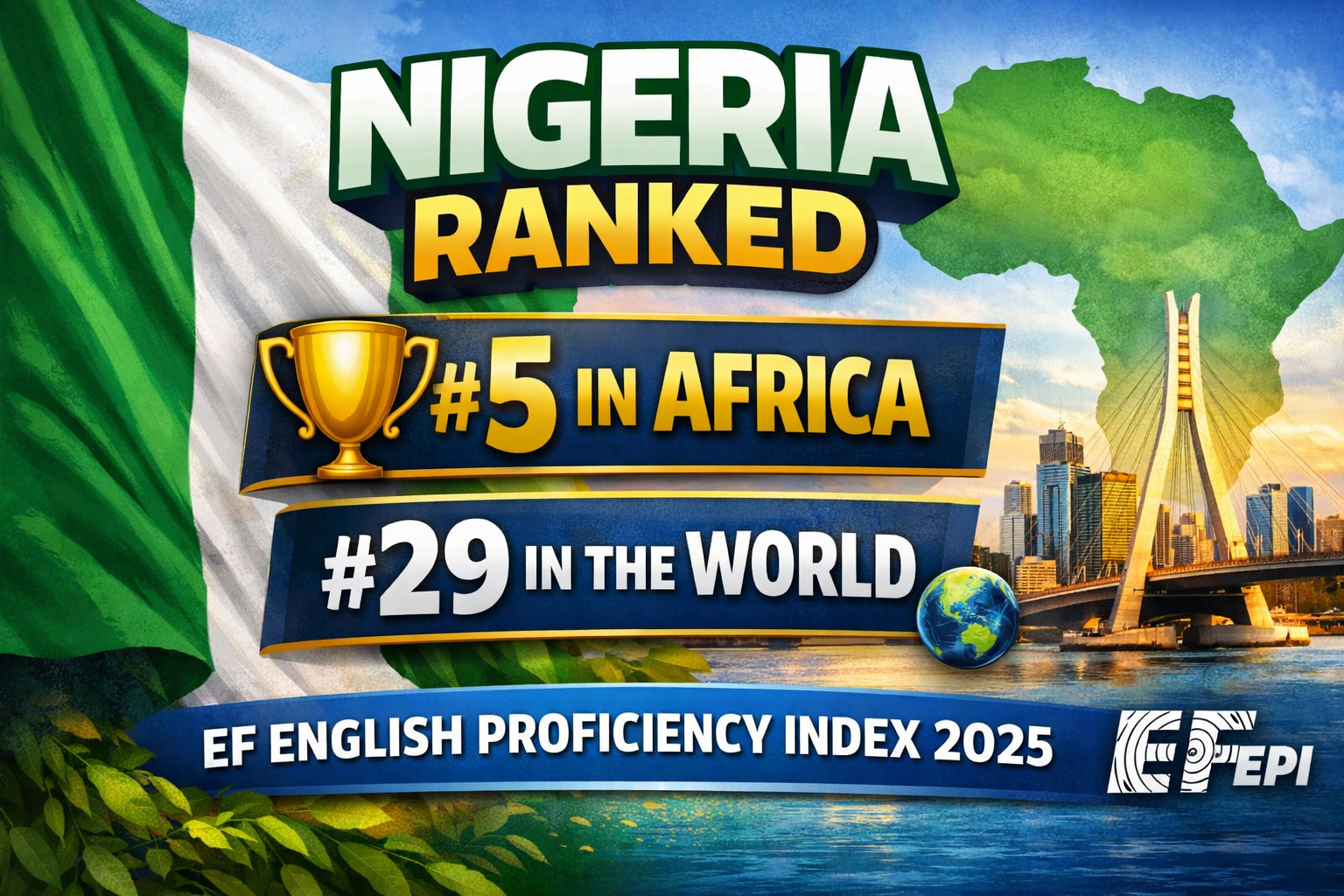
Nigeria has been ranked as the 5th best English-speaking country in Africa and 29th in the world, according to the 2025 edition of the EF English Proficiency Index (EF EPI) published by Education First (EF), a global leader in culturally immersive education. This index assesses adult English language skills across 123 countries and regions worldwide and is regarded as the most comprehensive evaluation of English proficiency.
According to EF, “English remains the world’s most widely shared language for international communication. In a time of growing global complexity, its role as a common bridge between cultures, economies, and ideas is more important than ever,” stated Kate Bell, the author of the EF EPI and EF’s Head of Assessment.
The EF EPI 2025 is based on the results of 2.2 million test takers who completed the EF Skills Evaluation Technology (EF SET), which is the world’s largest free standardised English test available for both individuals and organisations. Notably, this year’s report marks a milestone as it assesses speaking and writing skills for the first time, utilising proprietary artificial intelligence technology developed by Efekta Education Group, EF’s education technology division.
Globally, South Africa’s English language skills rank 13th in the world and first in Africa, making it the highest-ranked nation on the continent. It is closely followed by Zimbabwe, which also ranks 13th globally and second in Africa. Kenya and Zambia are ranked 19th and 27th globally, placing them third and fourth in Africa, while Nigeria stands at 29th worldwide, emerging as the fifth-best English-speaking country in Africa.
Here’s a breakdown of the top-ranked English-speaking countries in Africa:
- South Africa: South Africa leads Africa in English proficiency due to the widespread use of English in government, education, media, and business. As an official language, it serves as a unifying medium in a multilingual society and is essential for commerce and higher education.
- Zimbabwe: English is the primary language of instruction and administration in Zimbabwe. High literacy rates and a long-standing British educational influence contribute to strong English proficiency.
- Kenya: English, alongside Swahili, is an official language in Kenya. It is widely used in schools, courts, government institutions, and urban professional settings, which supports the country’s strong performance.
- Zambia: English is Zambia’s official language and is the main medium of instruction in schools. Its consistent use in governance and education has bolstered the country’s English proficiency.
- Nigeria: Nigeria ranks among Africa’s top English-speaking nations. English serves as the official language and primary means of communication, widely used in education, governance, media, and business.
- Ghana: English is Ghana’s official language and the main medium of instruction from primary to tertiary education. Its use in public administration and international engagement helps strengthen proficiency levels.
- Uganda: English is Uganda’s official language, commonly used in schools, government, and professional environments. It also plays a significant role in regional trade and diplomacy.
- Ethiopia: While not officially recrecognisednglish is widely taught in secondary schools and universities, serving as the main language for higher education and international affairs.
- Tunisia: The use of English is increasing in Tunisia, especially among youth and professionals. While Arabic and French dominate, English is becoming increasingly important in technology, tourism, and higher education.
- Morocco: English is gaining popularity in Morocco among students and the business community, viewed as a crucial tool for global trade and international relations.